Senegal
Guantanamo DiarySenegal is where Mohamedou Ould Slahi’s expected homecoming turns into an international detention operation. He arrives in Dakar to meet his brothers and continue to Mauritania, but is arrested almost immediately; within days, officials have taken him across the border on a private plane. Senegal is thus both the place of the first seizure in the journey and the setting for a consequential dispute over who held him, who knew where he was going, and what the transfer meant.
Arrival and arrest in Dakar
Slahi had left Canada after his mother urged him either to bring her there or return to Mauritania. On January 21, 2000, he flew from Montreal through Brussels to Dakar. The route was practical: flying to Dakar cost substantially less than flying directly to Nouakchott, about 300 miles away, and his family had arranged to collect him. In Brussels, he rested at an airport club with a fellow traveler, then boarded Sabena Flight 502 for Dakar.
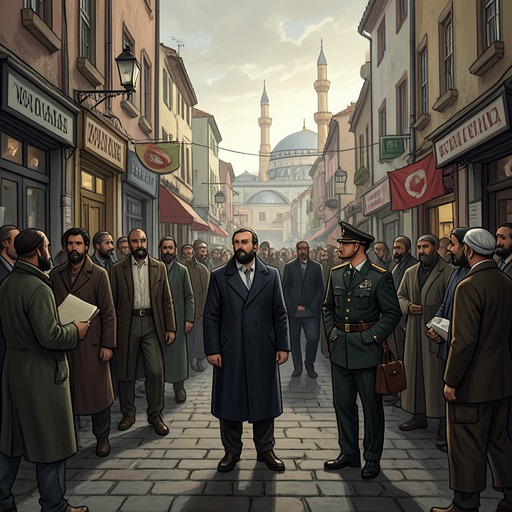
The flight arrived around 11 p.m. After collecting his bag, Slahi encountered his traveling companion again and said goodbye. Outside the airport, his brothers and two friends were waiting. As the group crossed the road toward the parking area, men suddenly shackled Slahi’s hands behind his back and cut him off from his companions. At first he thought he was being robbed. A special agent told him, “We arrest you in the Name of the Law.” Slahi called to his brothers, who heard him; later, one teased him for calling for help. He did not then know that both brothers and both friends had also been arrested.
The arrests turned an ordinary family pickup into a group detention. One of the friends had traveled with the brothers from Nouakchott; the other, who lived in Dakar, had joined them for the airport ride. Slahi describes the latter’s arrest as sheer bad luck. His companions were questioned before him during a long night, and he recalls that his turn came shortly before daylight.
Interrogation and transfer
In the interrogation room, a Senegalese interrogator and recorder were present, alongside a police chief and an American who took notes and sometimes passed notes to the interrogator. The police chief, Slahi says, was not part of the questioning and repeatedly fell asleep. The interrogator produced a thick stack of papers from a bright yellow envelope and said there were serious allegations against Slahi. Slahi recognized that the material concerned accusations he had already faced in Canada, including the Millennium Plot.
After leaving the police station, Slahi was driven to the airport in a Mitsubishi SUV. He silently read his Qur’an during the ride. He recalls that Senegalese officials did not confiscate it, unlike officials in Mauritania, Jordan, and the United States. At the terminal, the group passed through the diplomatic channel, while the interrogator and an American displayed badges and led the way. Slahi interpreted this passage around normal airport procedures as evidence that Senegal lacked meaningful control over what was happening: the transfer, in his view, resembled a foreign power acting through local territory.
He expected to board a scheduled Air Afrique flight to Nouakchott. Instead, officials took him to a small white plane already running its engines. The plane was so cramped that the passengers had to bend forward to fit; Slahi and a large guard squeezed into the back, facing the inspector, and the aircraft appeared overloaded. Its French pilot spoke with the inspector during the trip. The distance was only about 300 miles, and she estimated a flight time of 45 minutes to an hour, depending on the wind. The American and the interrogator stayed behind until the plane had taken off.
Public handover and contested responsibility
In Mauritania, Slahi asked the inspector to tell his family that he was in the country. The inspector did so, contrary to Slahi’s expectation. Senegalese officials also issued a public statement saying that they had handed him over to his own country. Slahi reports that both Mauritanian and American officials were angry about the announcement. The contrast is striking: the same transfer that moved him out of Senegal was not kept wholly invisible, even as the Americans and Mauritanians objected to the public account of it.
Slahi later reconstructed a possible behind-the-scenes exchange in which Senegalese officials said they had found no evidence and could not continue holding him, while the United States said it could not take him without evidence. He presents this as an inference rather than a witnessed conversation. In his account, Senegal did not want responsibility for a case in which either releasing him or transferring him could bring pressure from another government. The memoir’s uncertainty matters: the airport journey is narrated as direct experience, while the officials’ supposed negotiation is explicitly imagined from the circumstances.
A judicial timeline later included the January 2000 flight from Canada, the brothers’ meeting with Slahi in Senegal, the arrests, questioning about the Millennium Plot, and an American taking photographs. It records that someone Slahi presumed to be American flew him to Mauritania for further questioning. The timeline also places the Senegal–Mauritania episode between January 21 and February 19, while another entry states that he was released on February 14 after authorities concluded there was no basis to believe he was involved in the Millennium Plot. These records frame the Senegal arrest as an early episode in a case that officials did not substantiate with evidence of his involvement.
Senegal as the first threshold
The Dakar arrest begins what the book calls Slahi’s “endless world tour” of detention and interrogation: roughly twenty thousand miles over the next eighteen months, across four countries, often involving Americans and undertaken at the United States’ behest. The planned family reunion is the threshold into that itinerary. Senegal is not simply the point on a map between Canada and Mauritania; it is where ordinary travel gives way, in less than a second, to shackles, interrogation, and an undisclosed transfer.
The place also remains significant for the distinctions Slahi draws between the people and authorities he encounters. Senegalese officials let him retain his Qur’an during the drive, contacted his family when asked, and publicly described the handover. Those acts did not prevent his removal or resolve the dispute over control, but they differ from the secrecy that would characterize later stages of his detention. Senegal’s part in the narrative is therefore a combination of cooperation in the transfer and moments of disclosure that make the operation harder to present as a seamless, invisible process.